19th century
The beginning
The family lays its first saffron beds in the villages of Absheron. The corms pass from father to son — not as seed, but as inheritance.
The Absheron peninsula is one of the few places in the world where saffron grows: salt wind, sandy soil, dry summers. Our family has planted saffron on this land for more than a hundred and fifty years.
The family lays its first saffron beds in the villages of Absheron. The corms pass from father to son — not as seed, but as inheritance.
Rajab Huseynov begins work in the fields beside the Zafaran state farm. In those years Azerbaijan was the only republic in the USSR to grow saffron on an industrial scale.
The founder. He turns the family craft into a brand: AZSAFFRON. MIKTEA tea carries his name.
Owner and chief executive. The aim is simple to state and hard to achieve: to make the finest saffron products in the world. The fields now stretch from Absheron to Barda and Fuzuli.
She takes saffron from the kitchen to perfumery: working with perfumers, she creates the Private Collection and SARA Cosmetics.
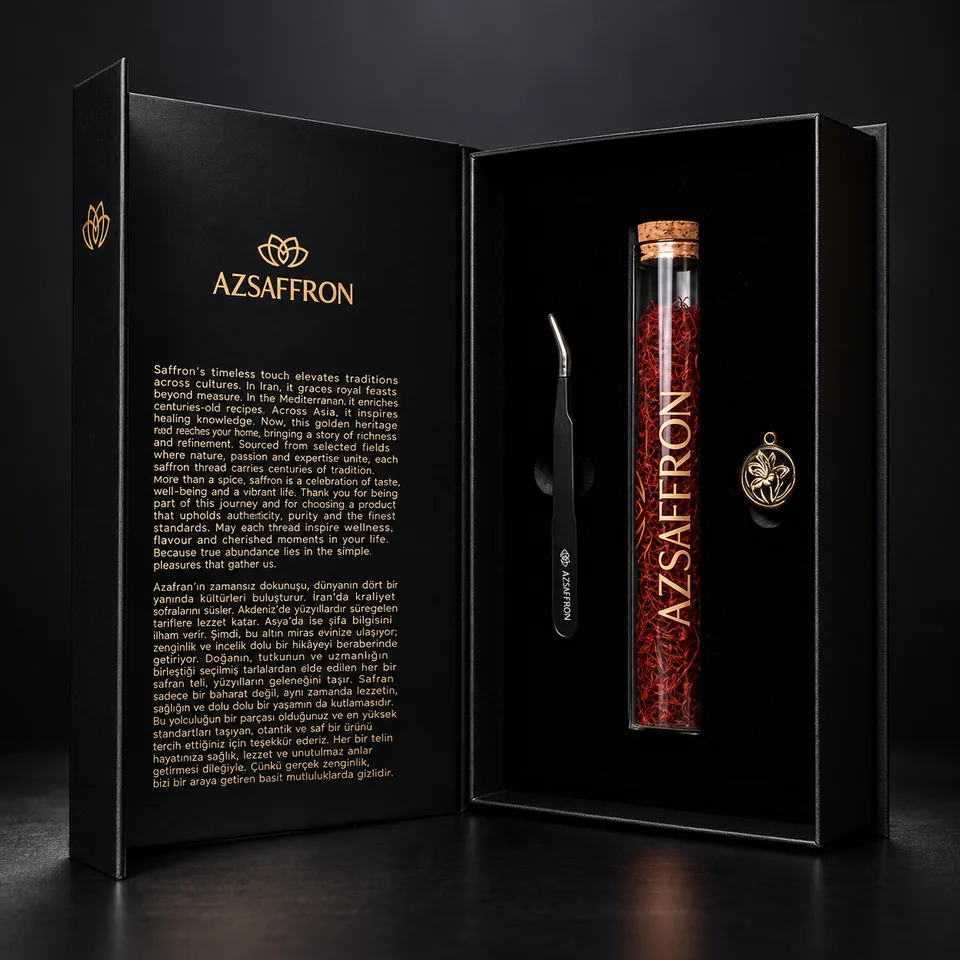
Saffron likes a hot, dry summer and a mild, rainy autumn. Absheron has both. Nizami Ganjavi wrote of the healing power of saffron as early as the 12th century — this plant is no stranger to this land.
The flower is picked at dawn. The stigmas are separated by hand the same day, dried and packed in tightly sealed glass. A kilogram of saffron takes 150,000–200,000 flowers.
Every batch is tested to the ISO 3632 standard in accredited European laboratories. The result: Category I, no artificial dye detected.
colouring strength · threshold ≥ 200
flavour · threshold ≥ 70
aroma · range 20–50